
Understanding Lauderdale County Releases
A release from the Lauderdale County Detention Facility means that facility recorded the end of its custody. It does not always mean the person returned to the community. The sheriff may have released someone on bond, after time served, under a court order, or into probation. The same departure can be a transfer to the Mississippi Department of Corrections, another county, the U.S. Marshals Service, or immigration authorities. The legal reason and next destination must come from the release entry, receiving-agency notation, or court record.
The distinction is vital because Lauderdale County has two adult custody systems. The sheriff operates the county jail, while East Mississippi Correctional Facility is a state prison run by Management & Training Corporation under MDOC oversight. County jail releases can appear in the sheriff's rolling released view. State-prison movements belong in MDOC Inmate Search, Parolees Search, MDOC Records, and MS SAVIN. A person on parole or earned release supervision has left secure confinement but remains under legal control. A complete discharge is different again.
- Release
- The recorded end of one facility's custody.
- Transfer
- A move to another custodian, not freedom from custody.
- Parole
- Conditional community supervision authorized by the State Parole Board.
- Earned Release Supervision
- Community placement in which the person remains an inmate under MDOC authority.
- Discharge
- The supported end of the sentence or supervision, shown by a final agency record.
Which Lauderdale Court Has Records?
Once the sheriff's short public window closes, the right court can explain why Lauderdale County custody ended. Circuit Court handles felony criminal cases. Justice Court handles the local misdemeanor matters described by the county and conducts initial appearances, preliminary hearings, and bond hearings. County Court shares criminal jurisdiction, may receive noncapital felony cases, and hears appeals from Justice and Municipal courts. Meridian Courts and Records routes municipal matters.
Ask for the docket and the document that answers the question, such as a bond order, dismissal, judgment, sentence, jail-credit entry, probation order, revocation, or completion order. A court order can authorize release before the jail finishes processing. Pair it with the jail timestamp when the exact physical departure matters. The Lauderdale court-system directory helps identify the correct clerk.
The official court routes are visible in the county's own directory.
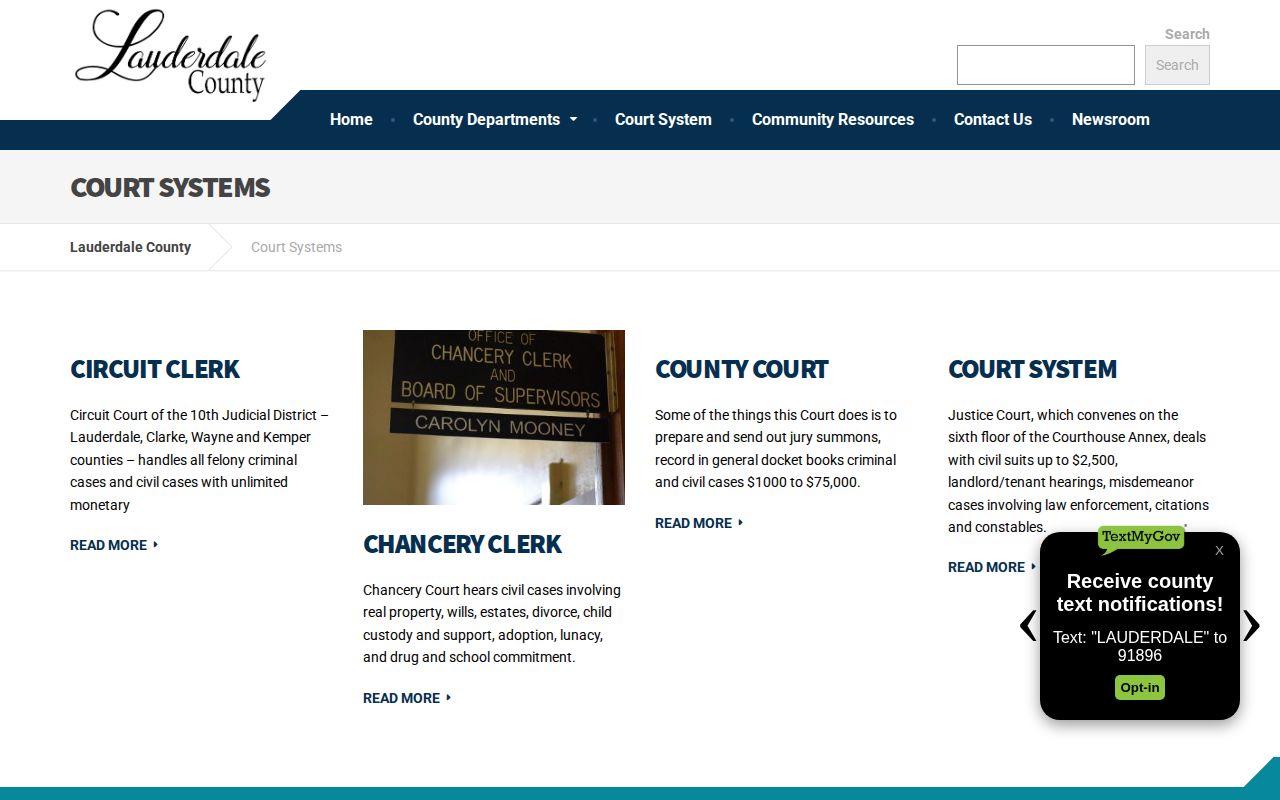
That division keeps a felony disposition, a Justice Court bond matter, and a Meridian municipal record from being sent to the wrong office.
Scale of Lauderdale County Custody
The sheriff describes the county facility as a long-term jail authorized for 290 people, with twelve pods, 144 holding cells, special-needs space, a medical-area cell, and a suicide-prevention cell. County food-service procurement reported an average daily population near 190 for its stated 2025 measurement period. These are measures of operating scale. They are not annual release totals or an average length of stay.
No sourced Lauderdale annual release count was found. The public list should not be totaled casually because its rolling window changes and transfers may appear beside community departures.
Property After Lauderdale County Release
The sheriff's FAQ documents one narrow property process. Books that are not allowed inside may be released to a named person when the incarcerated person signs a Property Release Form. That fact does not establish a broad gate-property policy for clothing, money, identification, medication, or other belongings. Call the detention line about the specific item instead of assuming the book procedure applies.
For a state release, MDOC identifies the case manager and discharge certificate as key parts of processing. The public research did not verify a general Lauderdale jail release-exit time, family waiting area, transportation plan, or full property-at-discharge rule. Those gaps should be handled through direct facility confirmation.
Note: A signed book-release process should not be presented as proof that every item can be collected by the same method.
Two Lauderdale Release Systems
Lauderdale's most important local distinction is institutional. The Lauderdale County Detention Facility is the sheriff-operated adult jail. East Mississippi Correctional Facility is a state prison operated under contract and MDOC oversight. A departure from the county jail belongs in the sheriff's release entry and court file. A departure from EMCF belongs in statewide MDOC, Parolees Search, MS SAVIN, and discharge records.
Geography does not merge the records. A person released from EMCF does not enter the county's 48-hour list simply because both facilities are near Meridian. Likewise, an ordinary county bond release may never create an MDOC record. The last custodian determines the first search.
Preserve Lauderdale Discharge Documents
The Mississippi Center for Justice expungement program serves applicants statewide. Its document guidance highlights the indictment, sentence, discharge order, or misdemeanor court abstract. Those durable documents become especially useful after a roster image disappears or an old booking reference remains without its later outcome.
Mississippi section 99-19-71 governs expungement eligibility. Eligibility depends on the record and current law, so a person should not infer that a missing web profile means expungement or that an old image defeats an order. Preserve the final court and discharge papers, then seek qualified legal help for an individual case.
How Lauderdale County Custody Ends
The public Lauderdale released roster does not display a Release Type or Release Reason field. Its bond figure is only a lead. A shown bond amount does not prove bond caused the departure, and zero does not prove dismissal or time served. Confirm the exact disposition before describing why a person left. The following routes show which record should be checked next.
| Departure | What it means | Best next record |
|---|---|---|
| Bond or recognizance | The court allowed release under stated terms. | Jail bond-release entry and operative court order |
| Time served or sentence end | Credited jail time satisfied the controlling order after holds cleared. | Judgment, jail credit, and release log |
| Dismissal or acquittal | The case ended without a conviction on that charge, though another hold may remain. | Court docket paired with jail movement |
| Probation | The court imposed community conditions instead of more confinement. | Sentencing order and supervising office |
| Parole or ERS | Secure state confinement ended while MDOC control continued. | MDOC status, Board record, and discharge paperwork |
| Transfer | One facility's custody ended but custody continued elsewhere. | Receiving-agency and transfer notation |
A medical release is a specialized MDOC community-corrections status under Mississippi law. A death must never be described as a community release. Both require direct, appropriate official confirmation. These labels should not be inferred from a missing roster entry.
Fields in Lauderdale Release Records
The sheriff's official rolling released roster gives useful preliminary evidence. It ties the person to a booking and supplies an exact recorded release time. It does not state the legal reason or destination, so the underlying release entry should be requested when those facts matter.
| Public field | What it can establish |
|---|---|
| Name and photograph | Identity clues tied to that booking, not guilt or present status |
| Booking number | The best key for a focused records request |
| Booking date and time | When the jail opened that custody record |
| Release date and time | When the jail recorded departure from its custody |
| Charges | Booking allegations that may later change |
| Bond amount | A route to the bond file, not proof of release reason |
| Arresting agency | Which authority brought the person into the booking process |
A complete request can add the release disposition, authorization, receiving agency, transfer date, bond-release entry, and releasable booking log. Court files may add the bond order, disposition, sentence, probation terms, or discharge order. Keep arrest, booking, court-order, physical-release, tentative-release, parole, maximum, and final-discharge dates separate. They answer different questions.
The sheriff warns that roster details cannot be certified for accuracy or authenticity, and profiles caution that charges and bail may change. Use the public timestamp as a strong lead, then confirm material details with Inmate Records or the court.
Request a Lauderdale Release Record
After the rolling window closes, use Lauderdale County's Request for County Records form. Address a jail request to the Sheriff or Detention Facility and ask that it reach Inmate Records. A narrow request is easier to match and less likely to produce avoidable cost.
- Give the full name, approximate booking or release date, facility, and booking number when known.
- Ask for the booking sheet, exact release date and time, disposition or reason, release authorization, and receiving agency or transfer notation.
- Request the booking photograph only when it serves the records purpose, and ask for segregable nonexempt portions if part is withheld.
- Ask for electronic delivery and a written cost estimate before work begins. No fixed local release-record fee was verified.
- If the reason came from a court, request the matching bond, dismissal, sentence, probation, revocation, or completion order from that court.
2001 5th Street
Meridian, MS 39301
24-hour detention: 601-482-9801
Sheriff administration: 601-482-9806
A public profile might remain reachable after it drops from the list, but Lauderdale promises no public archive beyond the rolling window. Agency retention and public web display are not the same. A sealed or expunged matter may restrict official access, while an old copy elsewhere can lack the later outcome.
Mississippi Law on Lauderdale Records
The Mississippi Public Records Act, sections 25-61-1 through 25-61-19, is the starting point for nonexempt sheriff records. Section 25-61-5 sets response rules. Without a written procedure, access is due within one working day. A procedure ordinarily may not place production or denial beyond seven working days. If production cannot occur by then, the agency must explain the delay and give a date, normally no later than fourteen working days absent an agreement or special exception.
Section 25-61-7 permits actual search, review, duplication, and mailing costs and allows prepayment. It does not create a fixed Lauderdale photo or release-record price. Juvenile material, protected victim facts, medical information, sealed or expunged matters, and some investigative material can be withheld or redacted. A requester may ask for the nonexempt remainder and the legal basis for any denial.
Find Released Lauderdale County Inmates
Start with the last known custodian and the date. A recent county departure, an older county case, a state-prison movement, and a federal transfer require different systems. Use names with a booking or MDOC number, age, dates, city, conviction county, or arresting agency. A name alone can match the wrong person.
- For a recent jail event, open the sheriff roster selector, choose the 48 Hour Release view, and compare the exact release timestamp and booking number.
- If the person vanished from Current but is not in Released, treat the result as unresolved. Check MDOC and MS SAVIN for a transfer or change event.
- For an older jail event, call Inmate Records, file a focused county request, and inspect the correct Lauderdale court.
- For state custody, use both MDOC Inmate Search and Parolees Search. Read Location, Unit, sentences, and Tentative Release Date in context.
- Use BOP or ICE only when federal or immigration facts support that jurisdiction. Ask the jail for the receiving agency when possible.
The Lauderdale 24-hour process manually isolates one day from the county's official 48-hour view. A predicted state date requires the separate MDOC release-date checks.
MDOC Search for Lauderdale Releases
The Mississippi Department of Corrections search has Inmate Search and Parolees Search routes. It is the proper starting point for EMCF and other state-custody records, not an archive of ordinary Lauderdale jail bookings. Search by first and last name or MDOC ID, then compare the location, unit, conviction county, sentence data, and identity fields.
| MDOC field | How to read it |
|---|---|
| MDOC ID | Stable state identifier for matching records |
| Location and Unit | Current institution or a community-supervision placement such as ERS |
| Entry and location-change dates | State-custody milestones, not county release times |
| Sentence and conviction county | The judgment context behind state custody |
| Tentative Release Date | A projected MDOC output, not proof that release occurred |
The MDOC landing page shows the separate inmate and parolee search routes.

A Parolees Search match can confirm release from prison into supervision. An ERS unit also indicates community placement while inmate status continues. Full discharge should be established through MDOC Records or the discharge certificate, not a past tentative date.
Lauderdale County's 48-Hour Releases
The sheriff publishes one official rolling view for people released within the last 48 hours. It is not a separate 24-hour list, a 72-hour archive, or a promised permanent index. The name box, Current and Released controls, booking-date and name ordering, newest or oldest sorting, profiles, and pagination help narrow the set. Each released row includes a photograph, booking number, booking and release timestamps, charges, and bond.
The official roster selector states the window.
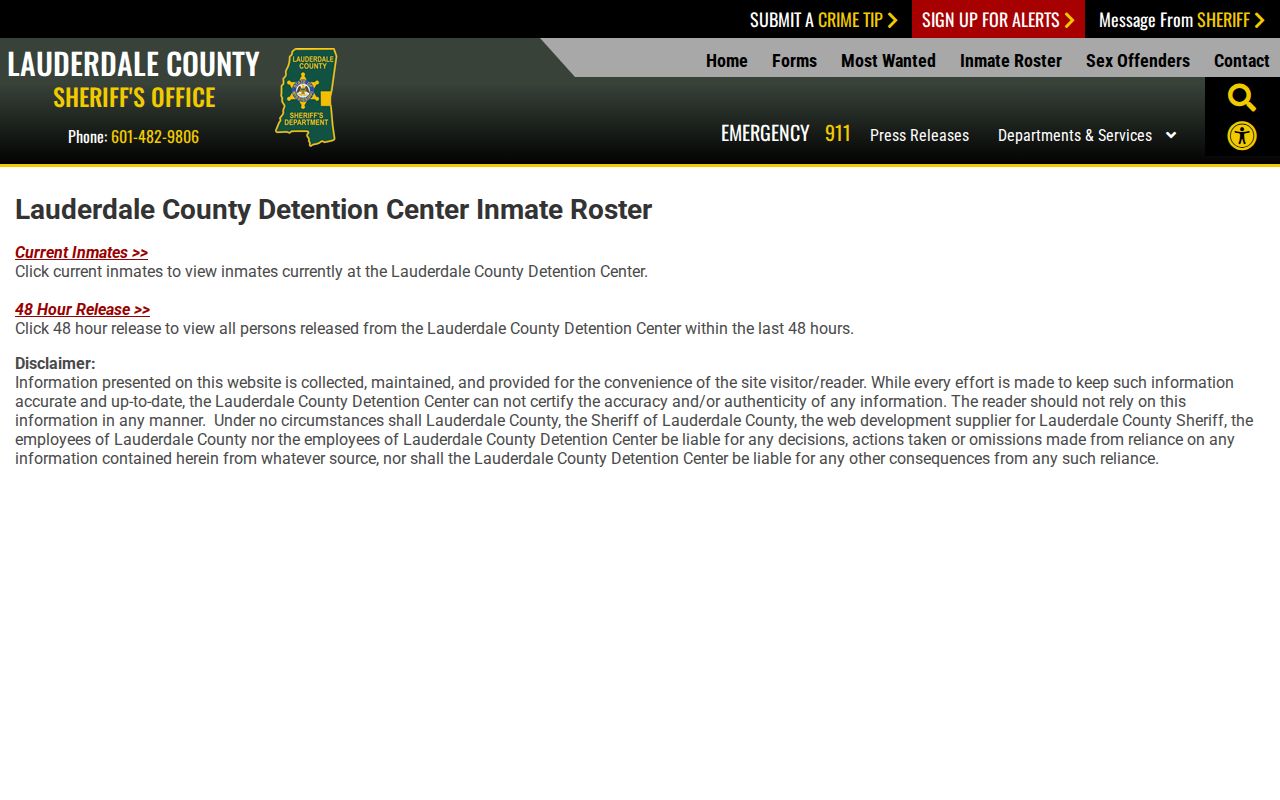
No scheduled batch time or minute-by-minute refresh promise was published. Read it as a rolling record and confirm a just-processed event with Inmate Records. For the third day or any older date, use the records form and the appropriate court.
Lauderdale Post-Release Supervision
Parole follows release from a prison sentence after Board action. Probation is imposed by a court, often instead of more confinement. Earned release supervision allows an eligible person to live in the community while remaining an inmate under MDOC jurisdiction. These terms are not interchangeable, and none means full discharge by itself.
Check the sentencing court for probation. Use MDOC Parolees Search and the Board or local office for parole and ERS routing. The Lauderdale Probation & Parole Office is at 1920 6th Street in Meridian and can help identify the proper supervision channel within disclosure limits. The post-release supervision record should reflect the local office, closed hearing process, and verification order.
Lauderdale Release Alerts and Transfers
MS SAVIN uses VINE and VINELink for participating Mississippi county jail and MDOC events. Choose Mississippi, match the person and supplying facility, and read the exact status. A Release from Custody event reports the agency's electronic update. Transfer, return, escape, and abscond events mean something else. Alerts can lag and are not certified discharge records.
Federal tools are narrower. The BOP Inmate Locator covers federal Bureau of Prisons custody and can show Released or Not in BOP custody. That wording does not rule out supervision or another custodian. ICE's locator mainly addresses current immigration detention. The U.S. Marshals Service has no general public released-person locator, so federal court records and direct agency confirmation may be needed.
The official BOP search illustrates the separate federal path.
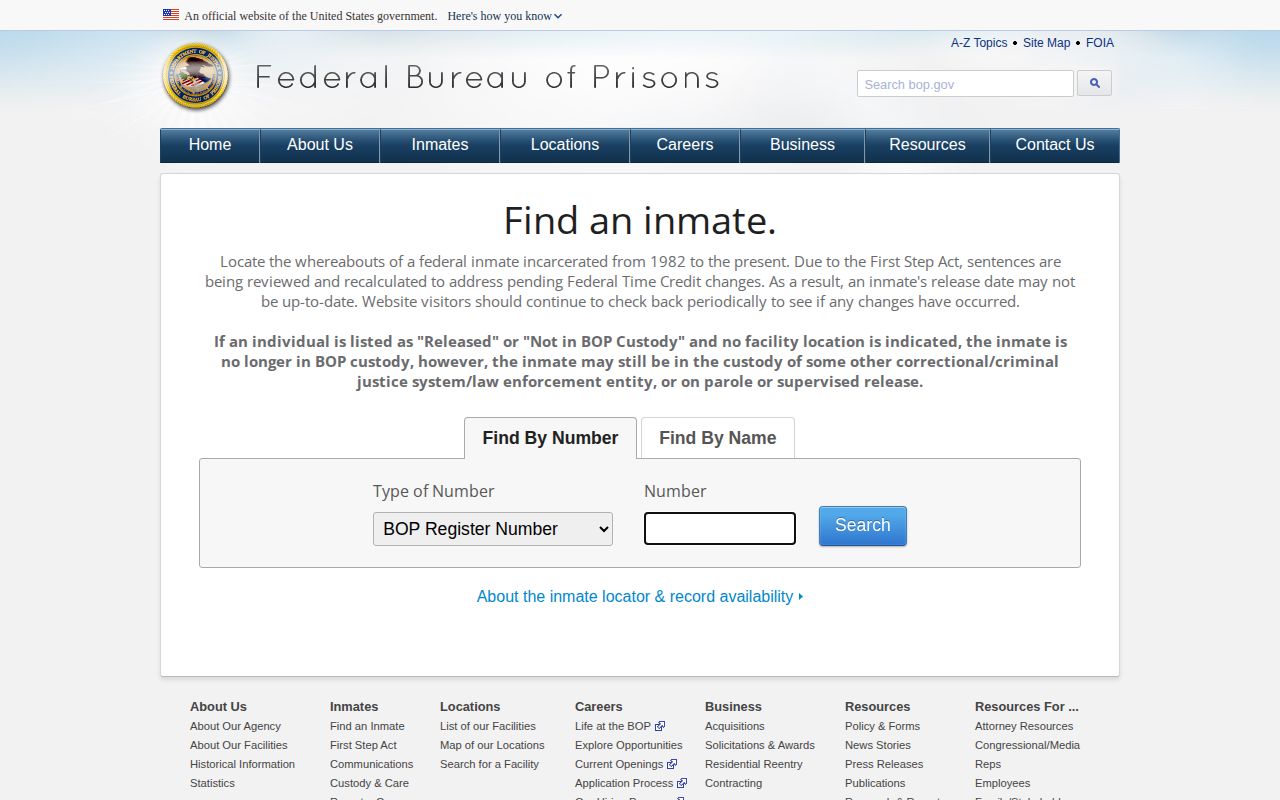
No BOP or ICE facility was confirmed in Lauderdale County. Use these tools only when the case facts indicate a federal or immigration transfer.
Where Lauderdale Release Records Appear
Use the system that owns the event. A live custody roster answers a present-custody question, while a release entry records departure. The following comparison prevents a no-result in one system from being treated as a final answer.
| Question | First source | Key limit |
|---|---|---|
| Still in Lauderdale jail? | Sheriff Current view | Absence does not prove release |
| Left Lauderdale jail recently? | Sheriff 48-hour Released view | No reason or destination field |
| Left Lauderdale jail earlier? | Inmate Records and court | Requires a focused request |
| State prisoner or parolee? | MDOC Inmate and Parolees Search | Tentative date is not actual release |
| VINE alert received? | Supplying jail or MDOC | Alert is not final sentence proof |
| Federal custody? | BOP locator and federal court | Not in BOP custody is jurisdiction-limited |
Q: Why did a released person vanish from the sheriff roster? The public release view promises only a rolling 48-hour window. After that, the underlying jail record and court file become the durable path.
Lauderdale County Release Facilities
Lauderdale County Detention Facility is the adult county jail. Its community departures can appear in the sheriff's 48-hour view; Inmate Records and the originating court provide the reason and durable record. East Mississippi Correctional Facility is a state prison under MDOC oversight. Its releases, transfers, parole, ERS, and discharge evidence come from MDOC, the Parole Board, MS SAVIN, and state records rather than the county feed.
No separate Meridian Police jail, local BOP prison, or local ICE detention facility was confirmed for the facility map. Meridian Police may still be named as an arresting agency, and federal or immigration authorities may receive a transfer. Those facts do not justify treating an unconfirmed holding place as a local release facility.