
Lauderdale County Parole and Probation
Parole and probation can both place a person under rules in the community, but they begin in different ways. The Mississippi Department of Corrections supervises parolees after the Mississippi State Parole Board authorizes release from confinement. Probation is imposed by a court. It may follow a jail term, a suspended sentence, or no prison confinement at all. A person released on earned release supervision, or ERS, remains an inmate under MDOC jurisdiction even while living outside a secure facility.
The Lauderdale County sheriff's released feed records a departure from the county jail. It does not identify parole, probation, or ERS. A displayed bond amount also does not prove the legal basis for release. The court order, MDOC record, and supervising office supply the status that the county feed lacks.
| Status | How it starts | Best verification source |
|---|---|---|
| Parole | Parole Board grant after eligibility and review | MDOC Parolees Search, Board record, and supervision office |
| Probation | Sentence or order from the proper court | Sentencing and probation orders, then the local office |
| ERS | MDOC placement under earned-release rules | MDOC location/status, Records, and discharge papers |
- Parole
- Conditional release from confinement under Board terms and MDOC supervision.
- Probation
- Court-ordered community supervision that may be imposed without a prison release.
- Discharge
- The formal end of the sentence or supervision, supported by a final agency or court record.
- Absconder
- A supervision status alleging that required contact or whereabouts have been lost; it must be verified.
Verify Lauderdale County Post-Release Supervision
Start with the custody system that last held the person. A Lauderdale County Detention Facility release should be paired with the court file because the sheriff feed does not label supervision. A release from East Mississippi Correctional Facility belongs in MDOC records, not the county's rolling list. Names can match, so use the MDOC number, booking number, dates, conviction county, and other non-sensitive identifiers before relying on a result.
- Open MDOC and use Parolees Search for a person believed to be on parole. A missing result is not proof that no supervision exists.
- Compare the MDOC ID, name, conviction county, location, unit, and dates. A community supervision location may show release from prison without full discharge.
- For probation, obtain the sentencing order, probation terms, later revocation papers, and any discharge order from the court that imposed the sentence.
- Contact the Lauderdale Probation & Parole Office when the public search is unclear or ordinary probation needs local routing.
- For a parole grant, denial, revocation, or final action, contact the Mississippi State Parole Board or request the releasable official record.
The broader path for confirming the original custody departure is available through the Lauderdale County released-inmate search and records coverage. That check helps separate a true community release from transfer to MDOC or another custodian.
Lauderdale County Supervision Office Details
Lauderdale County has a named MDOC community-corrections office in Meridian. That local presence matters when Parolees Search is ambiguous, when a court order shows probation, or when a person needs routing to the office shown in an official record. The office is not the source of the sheriff's jail release timestamp, and it does not replace the court that imposed probation. Disclosure limits may restrict what staff can confirm to a caller.
Lauderdale Probation & Parole Office
1920 6th Street
Meridian, MS 39301
Phone: 601-693-4713
Fax: 601-692-2770
The official office page names Jason Carney as Community Corrections Director. Use the contact as a status-routing fallback, not as a promise that personal case details will be released. A probation question may still require the Circuit, County, Justice, or municipal court record tied to the case.
The official Lauderdale office page shows the local facility record. The image below preserves that agency context without substituting for a live case check.
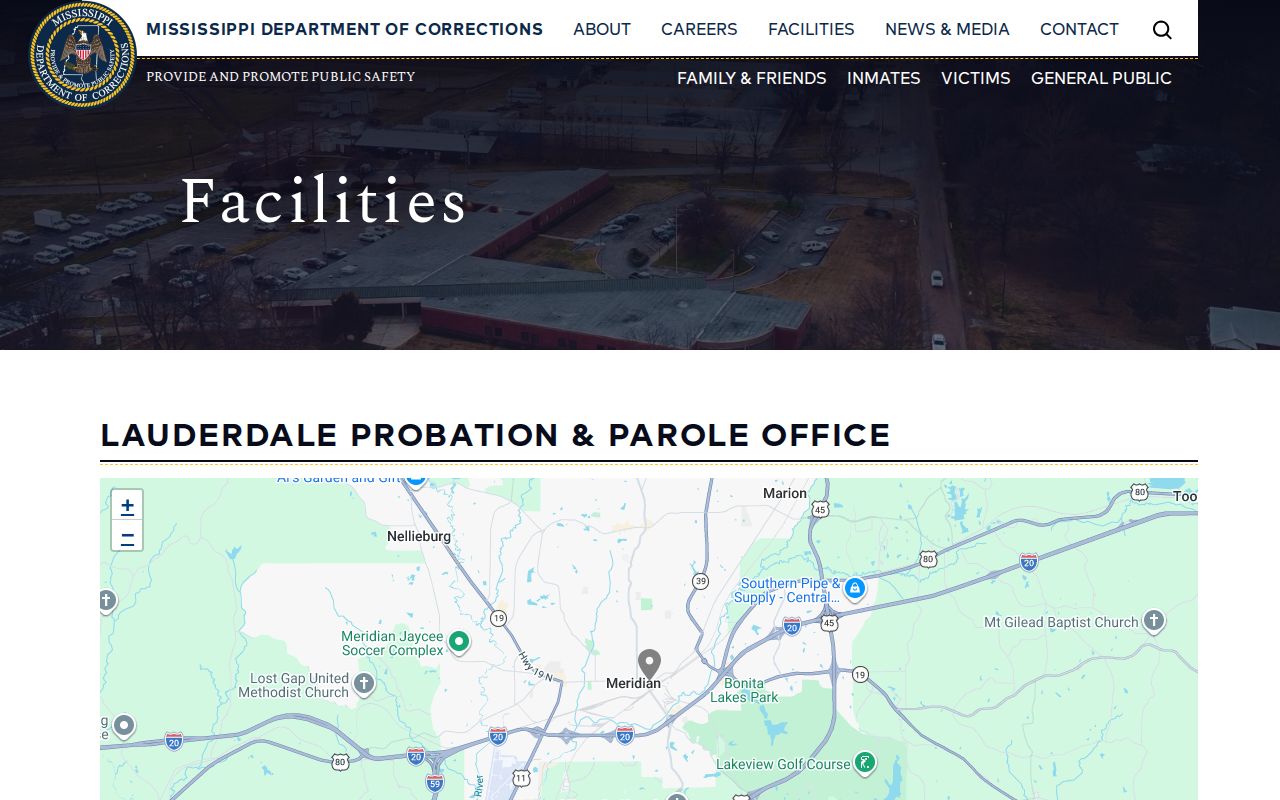
The office listing confirms a Meridian point of contact, while the person's court or MDOC file controls the actual supervision status.
Lauderdale County Supervision Status Changes
Conditions are the rules attached to parole, probation, ERS, house arrest, or another community status. The exact terms come from the Board action, court order, or MDOC paperwork. Common themes can include reporting, approved residence, travel limits, fees, programs, or conduct rules, but no general list should be treated as a person's order. House arrest is ordered by a court. MDOC may supervise it, yet MDOC cannot grant that status on its own.
A violation allegation can lead to review, a warrant, revocation proceedings, or return to custody. An absconder status means the supervising authority alleges that required contact or whereabouts were lost. It does not erase the fact that the person was released earlier. Mississippi SAVIN can issue an “abscond supervision” event, but that alert is not the final warrant or revocation record. Confirm it through the supervising office and the court or Board file.
No verified public Lauderdale County absconder list was found. Avoid old third-party lists and do not repeat an accusation without a current official record. For notifications, MS SAVIN/VINE distinguishes release, transfer, return to custody, escape, and abscond-supervision events. Those labels prevent a transfer from being mistaken for freedom from all custody.
Note: A supervision alert can lag agency action, so confirm a material status change with the office that supplied the event.
Lauderdale County Parole Hearing Records
The Mississippi State Parole Board has exclusive authority to grant or revoke parole. MDOC computes eligibility and supervises parolees. Under the Board's Title 29 Part 201 administrative rules, hearings are closed to the public. Board staff sets appointments and notifies the legal representative. No public online hearing calendar or searchable decisions database was located as of the research date, so a public portal should not be expected.
The official rules provide timing instead. MDOC prepares an eligible list each month. A hearing is held no later than the month before eligibility and may be considered in the eligibility month or either of the two preceding months. Review may occur through the file, in person, by phone, or by teleconference. A written decision follows deliberation within the rule's stated ten-day period. Verified outcomes are grant and deny. A denial action sheet gives reasons and a later hearing set-off.
The offender receives the decision, and victim or family notice is made in writing under the rules. Other requests require a stated reason and are handled case by case. The Board keeps a minute book of official actions and reasons. Contact the Board or use an MDOC records request, while recognizing confidentiality and disclosure limits.
Mississippi State Parole Board
239 North Lamar Street, Suite 501
Jackson, MS 39202
601-576-3520
MSStateParoleBoard@mdoc.state.ms.us
Lauderdale County Parole Eligibility Limits
Eligibility is the first possible review date, not a promise of release. Mississippi Code §47-7-3 and the rule set make the calculation depend on the offense, sentence date, and exclusions. The rules describe different percentage or time thresholds for certain nonviolent offenses, violent offenses, specified violent crimes, and some nonviolent drug offenses. Habitual, sex, capital, murder, human-trafficking, drug-trafficking, and no-parole statutes can exclude a person. Geriatric review can also have a distinct path.
Because the correct rule turns on the case, do not calculate a release date from a short roster entry. Check the judgment, MDOC time computation, eligibility notice, and Board action. A grant still does not prove that physical release has occurred. MDOC must finish release steps, clear holds, confirm an approved residence when required, and complete movement paperwork. The actual status should then agree with the MDOC location and parole record.
The MDOC directory lists both Records and Parole Board routes. MDOC Records can also supply a discharge certificate or releasable time record when a web result only shows a tentative date. That distinction is vital for someone released from East Mississippi Correctional Facility.
Note: A tentative or eligibility date describes a possible future event; only the later movement and discharge records show what occurred.
Lauderdale County Release Property Records
Release paperwork and personal-property rules come from different sources. Lauderdale's sheriff FAQ documents one narrow process: disallowed books may be released to a named person with an inmate-signed Property Release Form. That rule does not establish a broad policy for all property at the jail gate. It also says nothing about whether a person is on parole or probation.
For a state release, MDOC identifies the case manager and discharge certificate as central parts of release processing. The certificate is stronger proof of final discharge than a tentative web date. Someone moving to parole or ERS may have left secure custody but still remain subject to MDOC. Keep the movement record, supervision papers, and later discharge record together so each stage is clear.
The local FAQ can be checked at the Lauderdale County Sheriff's detention FAQ. Staff should be asked about the specific property category because no comprehensive public gate-property policy was located.
Lauderdale County Supervision Discharge Records
Post-release supervision ends through a formal record, not merely because a name disappears from a search. For probation, look for a court discharge or completion order and check for later revocation entries. For parole or ERS, obtain the MDOC or Board record showing completion, expiration, or discharge. A county jail timestamp proves only that Lauderdale County Detention Facility recorded a departure at that time.
Use precise terms. “Released to parole” means secure confinement ended under conditions. “Released to ERS” means community placement while the person remains under MDOC jurisdiction. “Discharged” should be used only when the final state or court record supports the end of the sentence or supervision. If records conflict, compare dates, identifiers, the supplying agency, and the exact status label before drawing a conclusion.
Mississippi's Public Records Act allows requests for nonexempt records, but protected information may be redacted. Ask for the parole action, supervision-status record, discharge certificate, or court completion order by name and case or MDOC number. A narrow request is easier to route and less likely to mix two people with similar names.